Your weekly glimpse into research in action at Southern Dairy Hub.
Insights
Herd test analysis: At each herd test we analyse how two and three year olds are performing compared to mixed aged cows. In the Standard herd, first and second lactation cows are tracking well against targets, with two year olds at 75% and three year olds at 85-90%. We believe this is largely due to younger cows being mobbed separately from older cows.
In the Future herd the picture is a little different. Due to the herd size of 208 cows, running a separate mob for younger cows is not practical. In this herd test, two year olds are performing lower than the mixed aged cows in this farmlet at 70%. We've also seen the Body Condition Score (BCS) drop by 0.1 over the past two weeks. As a result, we have lifted in-shed feed (grain/DDG blend) for two year olds in the Future herd. Once mating has finished, we'll look at additional options to priority-feed these animals on pasture.
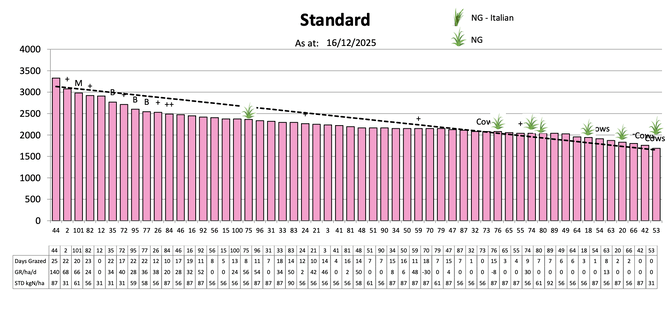
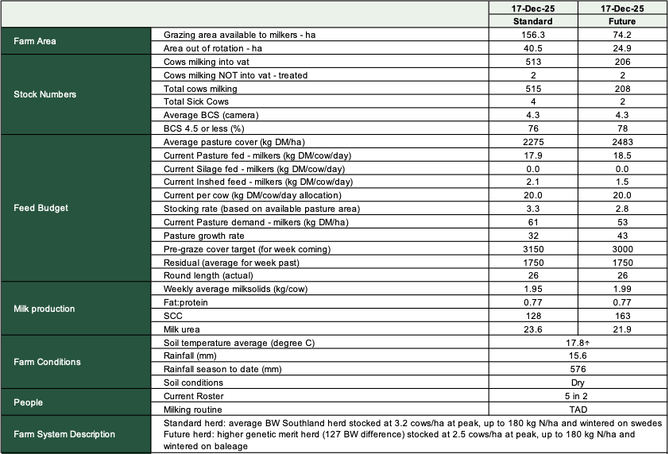
Feed wedge: As shown in the feed wedge below, the Standard farmlet is heading into a pasture deficit. We've reopened the silage stack to fill the gap and keep grass ahead of demand. Current growth is 32 kg DM per day, average pasture cover is 2,275 kg DM per hectare, and demand is 61 kg DM per day.
Silage quality is good at 34% dry matter (DM), and maintaining a strong buffer has been a key focus for managing feed deficits. We're continuing to apply Ravensdown N-Protect to support grass growth, particularly during periods of rainfall. In the Future herd, only three paddocks remain closed for baleage as we manage pasture quality at a lower stocking rate of 2.5 cows per hectare.

Milk urea: Milk urea trends are used throughout the season as an indicator of dietary protein intake. DairyNZ Low N Systems research identifies 20 to 30 mg/dl as the 'sweet spot' for grazing dairy cows. Current concentration levels across both farmlets sit between 20 and 27 mg/dl, indicating sufficient protein in the diet of both herds. Further detail is available in the October Field Day notes.
Calves off to grazing: The first 100 calves will head off to grazing next week, with the heaviest DNA-verified calves selected for this group.
Standard herd
Average BW Southland herd stocked at 3.2 cows/ha at peak, up to 180 kg N/ha and wintered on swedes.
Future herd
Higher genetic merit herd (127 BW difference) stocked at 2.5 cows/ha at peak, up to 180 kg N/ha and wintered on baleage.
If you have any questions about this week's HubWatch, please contact our team.