Your weekly glimpse into research in action at Southern Dairy Hub.
Insights
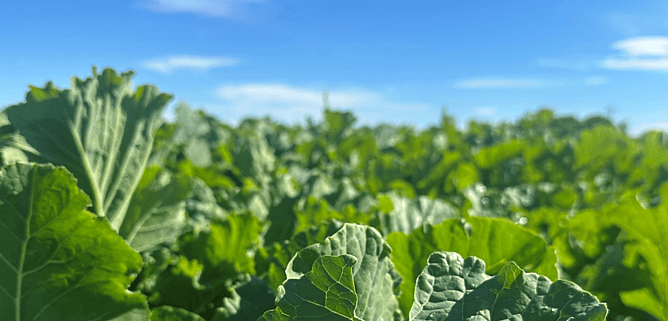
Winter crops: Our winter crops are growing very well. The crop pictured above is Firefly Kale, which has established strongly. We have one more application of Ravensdown N-Protect planned over the next week, which will be applied by drone.
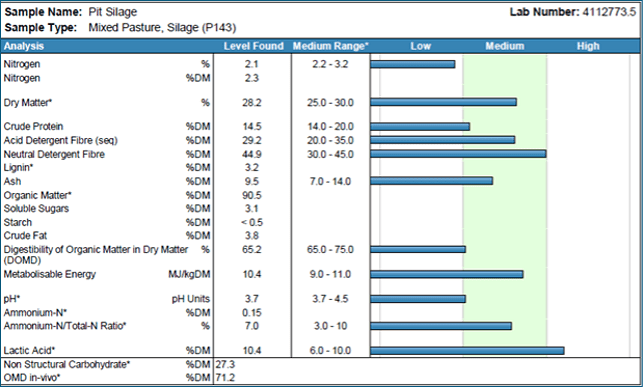
Silage quality results: Silage quality results have returned and we're relatively happy with both crude protein and metabolisable energy (ME). The dry matter percentage (DM%) was slightly lower than the previous sample taken when the stack was first opened, so we've adjusted the percentage used when calculating feed-out amounts.
Achieving consistent silage quality can be challenging when purchasing pasture to conserve rather than growing it ourselves. For this reason, we always test the grass before purchase to ensure it is as close as possible to our target specifications:
CP 15% DM | ME 12 MJ/kg DM | DM 35%.
Autumn regrassing: Three paddocks (two Standard and one Future) on the lower terrace have been taken out for regrassing. This area of the farm is not cropped, so it has a lower regrassing percentage.
We’re seeing variability in pasture growth on this terrace. Two paddocks were selected due to lower seasonal production, growing 6.7 and 7.7 t DM/ha season to date, compared with top paddocks producing over 12 t DM/ha. The third paddock required remedial work following the wet spring of 2024, which caused heavy pugging and rut marks.
The grass mix being sown is:
20 kg Accrue Perennial Ryegrass Superstrike
3 kg Legacy White Clover Superstrike
3 kg Quartz White Clover Superstrike
3 kg Ecotain Plantain Superstrike
Increasing plantain percentage remains a priority.
Baleage: Several paddocks are being cut for baleage this week, which will help build winter feed reserves.
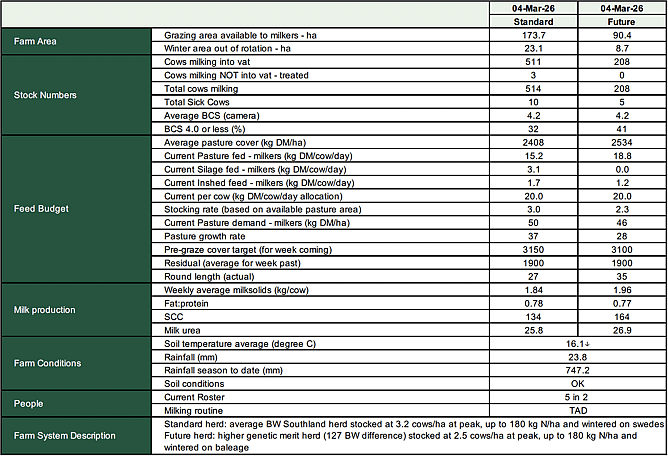
In-shed feed: We've decided to stop in-shed feeding for the Future herd. The goal for this herd has always been to prioritise homegrown feed. With high average pasture cover (2,534 kg DM/ha), cows not consistently hitting residuals, and pasture quality similar to the in-shed feed, the time is right to make the change.
Over the past couple of weeks the herd has only been receiving 1.2 kg DM/cow/day of in-shed feed on average, with around a third receiving none, so we expect minimal impact on daily milk production. Cows are a little slower heading to the platform however.
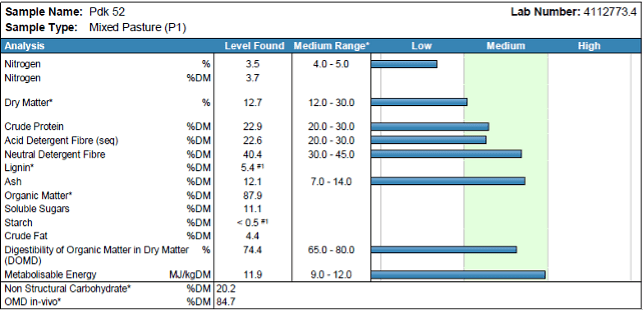
The table below provides a snapshot of pasture quality results from a Future herd paddock. The strong results support the decision to remove in-shed feeding for this herd.
Production: Milk production remains strong. The Future herd is producing 1.96 kg MS/cow/day, while the Standard herd is producing 1.84 kg MS/cow/day.
Season to date, the Future herd is 5% ahead of last season, and the Standard herd is 13% ahead on milk solids. Overall production is tracking ahead of budget.
Johne’s disease testing: Of the 11 cows tested after returning positive or high positive milk test results, all 11 have returned positive blood tests. These animals will be the first to leave the farm in the near future. Find out more about Johne's disease testing here.
Standard herd
Average BW Southland herd stocked at 3.2 cows/ha at peak, up to 180 kg N/ha and wintered on swedes.
Future herd
Higher genetic merit herd (127 BW difference) stocked at 2.5 cows/ha at peak, up to 180 kg N/ha and wintered on baleage.
If you have any questions about this week's HubWatch, please contact our team.